Progress Center’s Annual Meeting
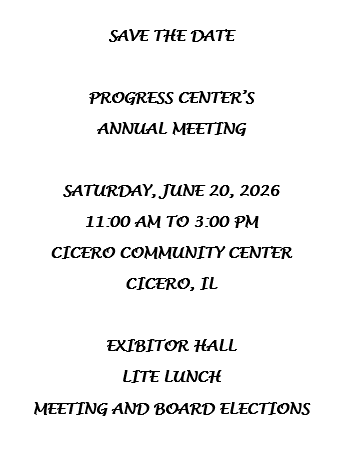
SAVE THE DATE
Progress Center’s Annual Meeting
SATURDAY, JUNE 20, 2026
11:00 am to 3:00 pm
CICERO COMMUNITY CENTER
CICERO, IL
EXIBITOR HALL
LITE LUNCH
MEETING and BOARD ELECTIONS
SAVE THE DATE
Progress Center’s Annual Meeting
SATURDAY, JUNE 20, 2026
11:00 am to 3:00 pm
CICERO COMMUNITY CENTER
CICERO, IL
EXIBITOR HALL
LITE LUNCH
MEETING and BOARD ELECTIONS
Statement on the Implementation of LEAD‑K
On behalf of Progress Center for Independent Living, which serves deaf, hard‑of‑hearing, and deaf‑blind children, adults, and their families, we strongly support the implementation of the Language Equality Acquisition for the Deaf, Hard of Hearing, and Deaf‑Blind Children Act (LEAD‑K).
Overview of Hearing Loss in Illinois
Children (Birth through School Age)
Adults
Why LEAD‑K Matters
Deaf and hard‑of‑hearing children in Illinois and nationwide face significant challenges in language development and literacy when they lack early, consistent access to language — particularly American Sign Language (ASL). Early language delays can affect academic success, social‑emotional growth, and lifelong opportunities.
We urge the State Board of Education, the Deaf and Hard of Hearing Commission, and the Department of Human Services to:
We commend the State Board and partner agencies for prioritizing language equality and early intervention. We remain committed to collaboration to ensure that every deaf, hard‑of‑hearing, and deaf‑blind child in Illinois has equitable access to language, literacy, and lifelong learning opportunities.
Sincerely,
Horacio Esparza
Executive Director
Progress Center for Independent Living
hesparza@progresscil.org
Declaración sobre la Implementación de LEAD‑K
En nombre de Progress Center for Independent Living, que apoya a niños, adultos sordos, con dificultades auditivas y sordociegos, así como a sus familias, expresamos nuestro firme respaldo a la implementación de la Language Equality Acquisition for the Deaf, Hard of Hearing, and Deaf‑Blind Children Act (LEAD‑K).
Panorama de la Sordera y Pérdida Auditiva en Illinois
Niños (desde el nacimiento hasta edad escolar)
Adultos
Por Qué es Importante LEAD‑K
Los niños sordos y con dificultades auditivas en Illinois y en todo el país enfrentan desafíos significativos en el desarrollo del lenguaje y la alfabetización cuando carecen de acceso temprano y consistente a un lenguaje completo, especialmente el American Sign Language (ASL). Los retrasos en el lenguaje pueden afectar el éxito académico, el desarrollo social‑emocional y las oportunidades de por vida.
Instamos a la Junta Estatal de Educación, a la Comisión para Personas Sordas y con Dificultades Auditivas, y al Departamento de Servicios Humanos a:
Reconocemos y aplaudimos el compromiso de la Junta Estatal y de las agencias asociadas por priorizar la igualdad en el acceso al lenguaje y la intervención temprana. Estamos comprometidos a colaborar para garantizar que cada niño sordo, con dificultades auditivas o sordociego en Illinois tenga acceso equitativo al lenguaje, la alfabetización y oportunidades de aprendizaje de por vida.
Atentamente,
Horacio Esparza
Director Ejecutivo
Progress Center for Independent Living
hesparza@progresscil.org
Did you miss our voter education workshops?
It’s midterm election year.
Join our one-hour individual voter education workshops to learn about the voting process – how to register to vote, where to vote, how to find out what’s on your ballot, how to learn about candidates running for office, and more. Come in person to one of our offices in Forest Park or Blue Island, or on Zoom.
For more information and to sign up and schedule your workshop, call Progress Center at 708-209-1500 ext. 118 or email dkaras@progresscil.org.
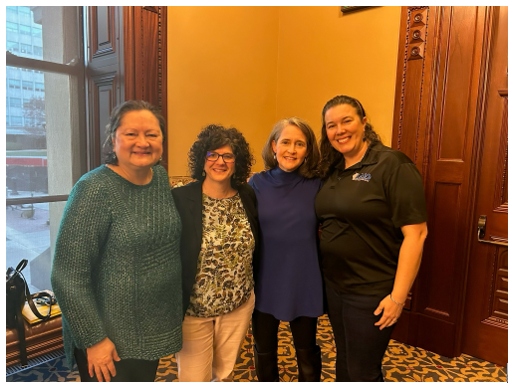
HUGE NEWS! HB1783 just passed out of House Committee!
A major win for our deaf community/education, Lead-K passed through the Education Policy Committee of the Illinois House of Representatives today! After years of hard work and advocacy, this bill will officially benefit deaf children. Thank you to everyone who called, emailed, and showed up to make their voice heard. Our LEAD-K (Language Equality & Acquisition for the Deaf Children-Kindergarten ready) team wants to thank Rep. Michelle Mussman to lead us all the way. She invested her belief in us.
Based on my experience, I learned English much later after 3rd grade because teachers did not teach me how to write English and they focused on teaching me how to speak even though I am profoundly deaf and can’t speak at all. They forcedly worked on my speech skills and hearing as well for four years. The education system has failed me. I have learned more at Illinois School for the Deaf and they provided communication accessible like American Sign Language. I do not want deaf children going through the same system as me for four years. The education system for Deaf Children needs to change. Through data analysis, we know LEAD-K will help deaf children’s milestones thrive.
Lastly, I wanted to thank Progress Center for Independent Living for allowing me to be part of the LEAD-K team.
For more information on LEAD-K, check the website: https://www.leadkfamilyservices.org/.
Next stop: Onto the House and Senate floors and to the Governor’s desk!
Carol Ann Nemecek-Kowalski, M.A.
Deaf Services Coordinator
Progress Center for Independent Living
From Rep. Michelle Mussman:
Creates the Language Equality Acquisition for the Deaf, Hard of Hearing, and Deaf-Blind Children Act. Provides that the State Board of Education, in cooperation with the Deaf and Hard of Hearing Commission and the Department of Human Services, shall establish a language assessment program for deaf, hard of hearing, and deaf-blind children, and select language developmental milestones. Sets forth provisions concerning the scope and purpose of the program and the development of a resource for use by parents and guardians. Provides that the State Board, in cooperation with the Deaf and Hard of Hearing Commission and the Department of Human Services, shall select tools or assessments for educators that can be used to assess the language and literacy development of all deaf, hard of hearing, and deaf-blind children. Sets forth provisions concerning the tools or assessments. Provides that beginning on July 1, 2026, a language assessment shall be given to each child who is deaf, hard of hearing, or deaf-blind and who is less than 6 years of age. Sets forth provisions concerning the assessment. Provides that an advisory committee on language assessment programs shall be established by the State Board, the Deaf and Hard of Hearing Commission, and the Department of Human Services. Sets forth the membership and duties of the advisory committee. Provides that on or before July 1, 2026, the State Board, the Deaf and Hard of Hearing Commission, and the Department of Human Services shall publish a joint action plan and may propose legislation and rules necessary to implement the recommendations of the advisory committee. Sets forth provisions concerning reporting and rulemaking. Effective immediately.
About Carol…
Carol Ann Stephanie Nemecek-Kowalski
Deaf Services Coordinator (23 years) at Progress Center for Independent Living.
Chicago – where else is better than Chicago?
Master’s in Sign Language Education from Gallaudet University, one of the only deaf and hard of hearing universities in the world.
My personal and professional goals are to consistently advocate for Deaf and hard of hearing consumers and make it an accomplishment.
A long list of relevant professional achievement, milestones and accomplishments.
Too many hobbies and love to play Pickleball with friends! I am very involved in Deaf community.
Adjunct instructor at College of DuPage American Sign Language (ASL).
Animal lover.
Contact Carol at 708.209.1500 (Voice), Sorenson VP: 708.689.1378, or caroln@progresscil.org.

Right before our March Membership & Outreach meeting, Progress Center will have a Shop-In. The Shop-In will take place at Old School Tavern at 201 Des Plaines Ave, Forest Park, IL 60130.
Shop-Ins are opportunities to show businesses the buying power and solidarity of the disability community, as well as check out accessibility of the location.
We will meet at Progress Center at 12:00 noon, and we will walk and roll to the restaurant, which is approximately two blocks / a quarter of a mile from Progress Center. Anyone who prefers to go directly to the restaurant can meet the group at 12:30 for lunch. We will leave around 2:00 pm to be at Progress Center for our hybrid M&O meeting at 2:30 to 4pm.
Call or email Demetra for more information at 705-209-1500 ext. 118 or dkaras@progresscil.org.