Event celebrates new ADA compliant gateway ramp

MWRD commissioners, Blue Island leaders and officials with the Progress Center for Independent Living, Blue Island Chamber of Commerce and accessibility and clean water advocates to formally cut the ribbon on new amenities at the MWRD’s Louis S. Viverito Sidestream Elevated Pool Aeration Station.
MWRD commissioners, Blue Island leaders and officials with the Progress Center for Independent Living, Blue Island Chamber of Commerce and Industry and accessibility advocates cut the ribbon on new amenities at the MWRD’s SEPA Station 3. 

Accessibility upgrades at the Metropolitan Water Reclamation District of Greater Chicago’s (MWRD) Sidestream Elevated Pool Aeration (SEPA) Station #3 were unveiled on May 8 in partnership with the City of Blue Island, the Blue Island Disability Committee, the Blue Island Chamber of Commerce, Progress Center for Independent Living and community members.

A new concrete ramp and segmented retaining wall were constructed to create an Americans with Disabilities Act (ADA)-compliant pathway, giving visitors of all ages and abilities safe and convenient access to the popular recreation site. Braille signage was also installed to support visitors with visual impairments.

“This SEPA Station has always been a gathering place, and these upgrades make it even more inviting,” said MWRD President Kari K. Steele. “By adding ADA-compliant features and braille signage, we’re opening the door for more people to experience the natural beauty and educational opportunities along the Cal-Sag Channel. This project reflects the MWRD’s dedication to accessibility, collaboration and environmental stewardship.”

The SEPA station aerates water to support aquatic life and enhances water quality in the Calumet-Sag Channel, while offering a scenic gathering place along the waterway. The MWRD operates five SEPA stations along the Calumet-Sag Channel. From April through October, these facilities collectively pump up to 1.3 billion gallons of water per day, adding 25 tons of oxygen to the Chicago Area Waterway System. At each station, the Cal-Sag Channel’s flow is elevated as much as 17 feet into shallow pools and then cascades over a series of waterfalls.

“The upgrades at SEPA Station #3 reflect the MWRD’s ongoing commitment to improving our facilities so they better serve the public,” said MWRD Vice President Patricia Theresa Flynn. “I was proud to see this project completed with the strong support of Blue Island and our partners. When we invest in accessibility, we invest in people—and that strengthens our entire region.”

“Access to public spaces is not a privilege; it is a fundamental right that guides the path toward inclusion,” said Horacio Esparza, executive director, Progress Center for Independent Living. “When every resident and their needs are considered, inclusion becomes the standard—and dignity the result. And when leadership and local authorities, like those in Blue Island, are truly committed, advocacy becomes not a struggle, but a natural and achievable action.”

Blue Island Mayor Fred Bilotto said the SEPA station park is one of the community’s true hidden gems.

“It is a public space where residents can gather with friends and family and generally enjoy nature,” said Mayor Bilotto. “The improvements we’re celebrating today will make that experience available to even more people. The new ADA-accessible pathway and braille signage represent more than just construction upgrades — they reflect a commitment to inclusion and ensuring that public spaces are welcoming and accessible to residents of all ages and abilities. On behalf of the City of Blue Island, we appreciate your commitment to strengthening our community and making spaces like this accessible for everyone.”

Robin Jones, the retired director of the Great Lakes ADA Center at the University of Illinois at Chicago, applauded efforts to make the SEPA station accessible.

“As we approach the 36th anniversary of the ADA, it is exciting to see local communities embracing the spirit of the ADA and assuring that their public spaces are accessible to and useable by everyone,” Jones said.

The station also serves as an economic engine that complements neighborhood businesses and attracts visitors in warmer months.

“Accessible public spaces like SEPA Station #3 are essential to a thriving community,” said Blue Island Area Chamber of Commerce and Industry Executive Director Sara Brown. “The Chamber has been a strong advocate for accessibility and inclusive economic growth, and these improvements represent meaningful progress toward that goal. When we invest in accessibility, we strengthen not only quality of life, but also the economic vitality of our local businesses and neighborhoods.”

Long‑time environmental advocate, community organizer, and friend to the Cal‑Sag Channel, Tom Shepherd expressed his gratitude toward the community investment.

On behalf of our community, we extend our sincere thanks to the Metropolitan Water Reclamation District and the City of Blue Island for their commitment to making this cherished site more accessible,” said Tom Shepherd. “These improvements ensure that people of all ages and abilities can safely enjoy the beauty of the Cal-Sag Channel and the Waterfall Park, reflecting a shared dedication to inclusion and public access.”

READ MORE

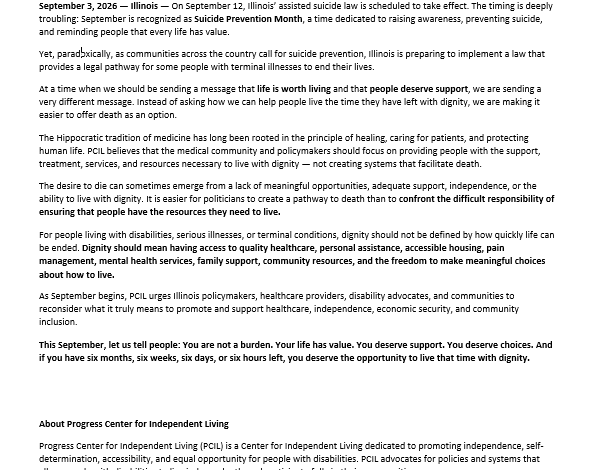
Webinar on Safe Spaces featuring Progress Center

What makes people feel safe, seen, and supported at work?

Join us for Part 3 of CCDPH’s literacy webinar series on May 15 to learn how organizations are building environments where people feel like they truly belong. Hear from AgeOptions and Progress Center staff and consumer as they share real examples of what works and why it matters.

📅 Friday, May 15
🕙 10:00 AM – 11:30 AM
📍 Virtual

✅ Open to all

Register: https://ow.ly/sNwE50YVi86

The May 15th webinar is focused on creating safe spaces and will discuss the importance of things like trauma-informed practices, inclusive language, and accessibility considerations for different populations.


READ MORE

Gran inauguración del Waterfall Park

Únase a Progress Center para inaugurar y celebrar la apertura de «Waterfall Park» en Blue Island, recientemente remodelado y ACCESIBLE. Asista al corte de cinta y a la conferencia de prensa, en los que nos uniremos a la Ciudad de Blue Island, al Comité de Discapacidad de Blue Island y al Distrito Metropolitano de Recuperación de Aguas del Gran Chicago.

DÓNDE: Estación n.º 3 de Aireación de Piscina Elevada en Corriente Lateral (SEPA), 2250 Fulton St., Blue Island, Ill. 60406

CUÁNDO: Viernes, 8 de mayo de 2026, a las 10:30 a. m.


READ MORE

Waterfall Park Grand Opening

Join Progress Center to open and celebrate “Waterfall Park” in Blue Island, newly remodeled and ACCESSIBLE. Attend the Ribbon Cutting and Press Conference as we join the City of Blue Island, the Blue Island Disability Committee, and the Metropolitan Water Reclamation District of Greater Chicago.

WHERE: Sidestream Elevated Pool Aeration (SEPA) Station #3, 2250 Fulton St. in Blue Island, Ill. 60406

WHEN: Friday, May 8, 2026, at 10:30 a.m.


READ MORE

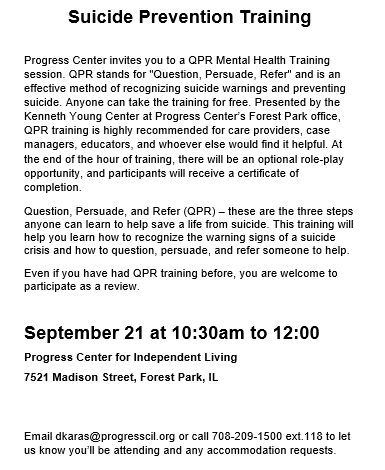
New Support Groups at Progress Center

Progress Center is starting two new Support Groups in April


Family Caregivers Support Group

The group is for caregivers of people with disabilities or others needing and receiving care from close relatives as a child, spouse, or parent. The intention is to foster an environment where people can be with others experiencing a similar situation to discuss topics and offer each other encouragement. Family caregivers are often in need of others who understand their position and support decisions made for their family, especially when faced with pressure to choose a nursing home.

Join others with similar family situations.

Meets every 2nd Monday of the month at 4:00pm.

First group meets on April 13.


Non-Apparent / Hidden Disabilities Support Group

The group is for people with hidden, invisible, or nonapparent disabilities, even dynamic disabilities (fluctuating, episodic, sometimes called “not always” disabilities). These are physical, mental, or neurological conditions not obvious from a person’s appearance. Examples include chronic pain, diabetes, learning differences like dyslexia, autism, mental health conditions like depression, and neurological conditions like migraine, vertigo, and multiple chemical sensitivity.

People with hidden disabilities are often overlooked, trivialized, marginalized, isolated, and discriminated against, even at times by people with apparent, sometimes referred to as “real”, disabilities. Disability status is more often denied and support is delayed. Accommodations may be considered unnecessary and withheld. People are often faced with a “you look fine” attitude of skepticism and accusations of faking.

Come share compassion with peers.

Meets every 4th Monday of the month at 4:00pm.

First group meets on April 27.


Both Support Groups will meet in-person at Progress Center in Forest Park and over Zoom (hybrid).

For more information, directions to our office or the Zoom link, call Demetra at Progress Center at 708-209-1500 ext. 118 or email dkaras@progresscil.org.

READ MORE

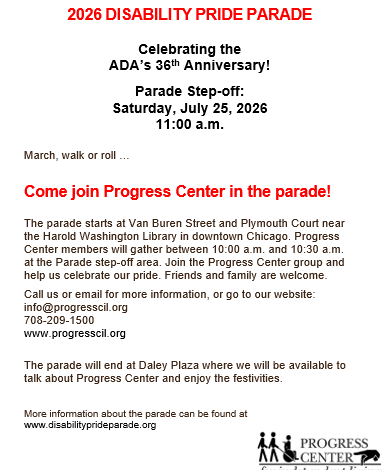
Progress Center’s Annual Meeting

SAVE THE DATE


Progress Center’s Annual Meeting

SATURDAY, JUNE 20, 2026
11:00 am to 3:00 pm
CICERO COMMUNITY CENTER
CICERO, IL

EXIBITOR HALL
LITE LUNCH
MEETING and BOARD ELECTIONS


READ MORE

Statement on the Implementation of LEAD-K (English and Spanish)

Statement on the Implementation of LEAD‑K

On behalf of Progress Center for Independent Living, which serves deaf, hard‑of‑hearing, and deaf‑blind children, adults, and their families, we strongly support the implementation of the Language Equality Acquisition for the Deaf, Hard of Hearing, and Deaf‑Blind Children Act (LEAD‑K).

Overview of Hearing Loss in Illinois

  • According to the U.S. Census Bureau’s American Community Survey, about 14.4 % of Illinois residents have some type of hearing loss (ranging from mild to profound). Of those, approximately 3.1 % are classified as deaf (severe or profound)— impacting tens of thousands of residents statewide. (idhhc.illinois.gov)
  • In Illinois’ largest city, Chicago, census estimates show over 85,000 residents identified as deaf. (idhhc.illinois.gov)

Children (Birth through School Age)

  • In the U.S., hearing loss is the most common congenital condition, with up to 3 in every 1,000 infants born with detectable hearing loss. (Illinois Department of Public Health)
  • Newborn hearing screening programs in Illinois now screen nearly all infants, allowing earlier identification of hearing loss and referral for early intervention services. (Illinois Department of Public Health)
  • National data also show a range of hearing loss among children and adolescents; some surveys have recorded hearing loss in 0.6 % of children ages 3‑17and higher for older teens. (CDC)

Adults

  • Among adults 12 years and older in the U.S., about 1 in 8 people have hearing loss in both ears — meaning hearing loss is common as people age.(Illinois Library Guides)
  • Illinois data indicate that significant numbers of adults across cities and counties live with hearing loss, underlining the lifelong nature of communication and language needs. (idhhc.illinois.gov)

Why LEAD‑K Matters

Deaf and hard‑of‑hearing children in Illinois and nationwide face significant challenges in language development and literacy when they lack early, consistent access to language — particularly American Sign Language (ASL). Early language delays can affect academic success, social‑emotional growth, and lifelong opportunities.

We urge the State Board of Education, the Deaf and Hard of Hearing Commission, and the Department of Human Services to:

  1. Ensure language assessments measure both ASL and English language milestones, recognizing early ASL access as critical for cognitive and literacy development.
  2. Provide accessible, culturally appropriate resources and guidance for families, guardians, and educators to support language acquisition at home and in school.
  3. Offer comprehensive professional development for educators to strengthen skills in teaching deaf, hard‑of‑hearing, and deaf‑blind children, with emphasis on ASL integration.
  4. Implement continuous monitoring and reporting, ensuring accountability, transparency, and ongoing improvements to the program.

We commend the State Board and partner agencies for prioritizing language equality and early intervention. We remain committed to collaboration to ensure that every deaf, hard‑of‑hearing, and deaf‑blind child in Illinois has equitable access to language, literacy, and lifelong learning opportunities.

Sincerely,
Horacio Esparza
Executive Director
Progress Center for Independent Living
hesparza@progresscil.org

Declaración sobre la Implementación de LEAD‑K

En nombre de Progress Center for Independent Living, que apoya a niños, adultos sordos, con dificultades auditivas y sordociegos, así como a sus familias, expresamos nuestro firme respaldo a la implementación de la Language Equality Acquisition for the Deaf, Hard of Hearing, and Deaf‑Blind Children Act (LEAD‑K).

Panorama de la Sordera y Pérdida Auditiva en Illinois

  • Según la Encuesta de la Comunidad Estadounidensedel Censo, alrededor del 14.4 % de los residentes de Illinois tienen algún tipo de pérdida auditiva (ligera a profunda). De estos, aproximadamente 3.1 % están clasificados como sordos (pérdida severa y profunda), lo que representa decenas de miles de personas en todo el estado. (idhhc.illinois.gov)
  • En Chicago, la ciudad más grande de Illinois, se estima que más de 85,000 residentes son sordos según datos del censo. (idhhc.illinois.gov)

Niños (desde el nacimiento hasta edad escolar)

  • En Estados Unidos, la sordera es la condición congénita más común, con hasta 3 de cada 1,000 recién nacidos con pérdida auditiva detectable. (Illinois Department of Public Health)
  • Los programas de tamizaje auditivo neonatal en Illinois examinan a casi todos los recién nacidos, lo que permite una identificación temprana y derivación a servicios de intervención temprana. (Illinois Department of Public Health)
  • Datos nacionales también muestran que algunos estudios identifican pérdida auditiva en 0.6 % de niños de 3 a 17 años, con tasas más altas entre adolescentes mayores. (CDC)

Adultos

  • Entre los adultos de 12 años o más en los Estados Unidos, aproximadamente 1 de cada 8 personas tiene pérdida de audición en ambos oídos — lo que subraya que la pérdida auditiva es común en la edad adulta. (Illinois Library Guides)
  • Los datos de Illinois reflejan que numerosos adultos en diversas ciudades y condados viven con pérdida auditiva, resaltando la necesidad de apoyo lingüístico y servicios continuos. (idhhc.illinois.gov)

Por Qué es Importante LEAD‑K

Los niños sordos y con dificultades auditivas en Illinois y en todo el país enfrentan desafíos significativos en el desarrollo del lenguaje y la alfabetización cuando carecen de acceso temprano y consistente a un lenguaje completo, especialmente el American Sign Language (ASL). Los retrasos en el lenguaje pueden afectar el éxito académico, el desarrollo social‑emocional y las oportunidades de por vida.

Instamos a la Junta Estatal de Educación, a la Comisión para Personas Sordas y con Dificultades Auditivas, y al Departamento de Servicios Humanos a:

  1. Garantizar que las evaluaciones de lenguaje midan tanto hitos en ASL como en inglés, reconociendo la importancia de la exposición temprana al ASL para el desarrollo cognitivo y de alfabetización.
  2. Proporcionar recursos y guías accesibles y culturalmente apropiados para familias, tutores y educadores que apoyen la adquisición del lenguaje en el hogar y en la escuela.
  3. Ofrecer desarrollo profesional integral para educadores, fortaleciendo sus habilidades en la enseñanza de niños sordos, con dificultades auditivas y sordociegos, con énfasis en la integración del ASL.
  4. Implementar monitoreo continuo y reportes públicos, asegurando responsabilidad, transparencia y mejoras oportunas del programa.

Reconocemos y aplaudimos el compromiso de la Junta Estatal y de las agencias asociadas por priorizar la igualdad en el acceso al lenguaje y la intervención temprana. Estamos comprometidos a colaborar para garantizar que cada niño sordo, con dificultades auditivas o sordociego en Illinois tenga acceso equitativo al lenguaje, la alfabetización y oportunidades de aprendizaje de por vida.

Atentamente,
Horacio Esparza
Director Ejecutivo
Progress Center for Independent Living
hesparza@progresscil.org


READ MORE

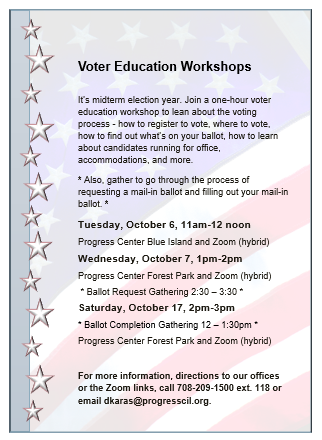
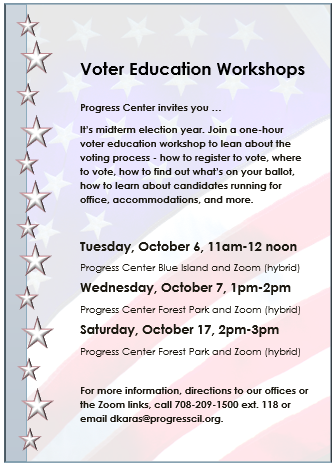
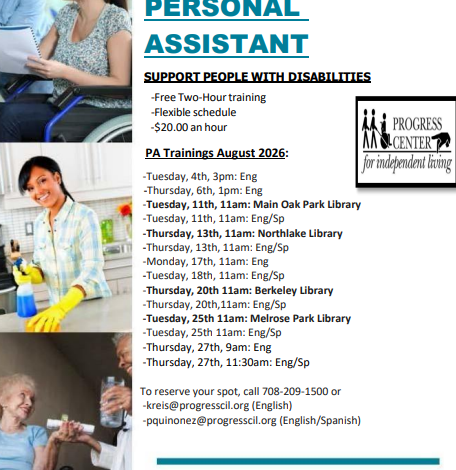
Voter Education Individual Workshops

Did you miss our voter education workshops?

It’s midterm election year.

Join our one-hour individual voter education workshops to learn about the voting process – how to register to vote, where to vote, how to find out what’s on your ballot, how to learn about candidates running for office, and more. Come in person to one of our offices in Forest Park or Blue Island, or on Zoom.

For more information and to sign up and schedule your workshop, call Progress Center at 708-209-1500 ext. 118 or email dkaras@progresscil.org.

READ MORE
Lead-K team and Rep. Mussman Co-chair Anita Cervantes-Bowen, Co-chair, Libby Oxenbaum, Rep. Michelle Mussman and IAD President Fara Harper

Lead-K

HUGE NEWS!  HB1783 just passed out of House Committee!

A major win for our deaf community/education, Lead-K passed through the Education Policy Committee of the Illinois House of Representatives today! After years of hard work and advocacy, this bill will officially benefit deaf children. Thank you to everyone who called, emailed, and showed up to make their voice heard. Our LEAD-K (Language Equality & Acquisition for the Deaf Children-Kindergarten ready) team wants to thank Rep. Michelle Mussman to lead us all the way. She invested her belief in us.

Based on my experience, I learned English much later after 3rd grade because teachers did not teach me how to write English and they focused on teaching me how to speak even though I am profoundly deaf and can’t speak at all. They forcedly worked on my speech skills and hearing as well for four years. The education system has failed me. I have learned more at Illinois School for the Deaf and they provided communication accessible like American Sign Language. I do not want deaf children going through the same system as me for four years. The education system for Deaf Children needs to change. Through data analysis, we know LEAD-K will help deaf children’s milestones thrive.

Lastly, I wanted to thank Progress Center for Independent Living for allowing me to be part of the LEAD-K team.

For more information on LEAD-K, check the website:  https://www.leadkfamilyservices.org/.

Next stop: Onto the House and Senate floors and to the Governor’s desk!


Carol Ann Nemecek-Kowalski, M.A.

Deaf Services Coordinator

Progress Center for Independent Living


From Rep. Michelle Mussman:

Creates the Language Equality Acquisition for the Deaf, Hard of Hearing, and Deaf-Blind Children Act. Provides that the State Board of Education, in cooperation with the Deaf and Hard of Hearing Commission and the Department of Human Services, shall establish a language assessment program for deaf, hard of hearing, and deaf-blind children, and select language developmental milestones. Sets forth provisions concerning the scope and purpose of the program and the development of a resource for use by parents and guardians. Provides that the State Board, in cooperation with the Deaf and Hard of Hearing Commission and the Department of Human Services, shall select tools or assessments for educators that can be used to assess the language and literacy development of all deaf, hard of hearing, and deaf-blind children. Sets forth provisions concerning the tools or assessments. Provides that beginning on July 1, 2026, a language assessment shall be given to each child who is deaf, hard of hearing, or deaf-blind and who is less than 6 years of age. Sets forth provisions concerning the assessment. Provides that an advisory committee on language assessment programs shall be established by the State Board, the Deaf and Hard of Hearing Commission, and the Department of Human Services. Sets forth the membership and duties of the advisory committee. Provides that on or before July 1, 2026, the State Board, the Deaf and Hard of Hearing Commission, and the Department of Human Services shall publish a joint action plan and may propose legislation and rules necessary to implement the recommendations of the advisory committee. Sets forth provisions concerning reporting and rulemaking. Effective immediately.

READ MORE
Carol pictured here on the right with coworker Esther during the St. Patrick's Day parade.

Staff Spotlight: Carol Nemecek-Kowalski

About Carol…


Carol Ann Stephanie Nemecek-Kowalski

Deaf Services Coordinator (23 years) at Progress Center for Independent Living.

Chicago – where else is better than Chicago?

Master’s in Sign Language Education from Gallaudet University, one of the only deaf and hard of hearing universities in the world.

My personal and professional goals are to consistently advocate for Deaf and hard of hearing consumers and make it an accomplishment.

A long list of relevant professional achievement, milestones and accomplishments.

Too many hobbies and love to play Pickleball with friends!  I am very involved in Deaf community.

Adjunct instructor at College of DuPage American Sign Language (ASL).

Animal lover.


Contact Carol at 708.209.1500 (Voice), Sorenson VP: 708.689.1378, or caroln@progresscil.org.


READ MORE
Progress Center
Privacy Overview

This website uses cookies so that we can provide you with the best user experience possible. Cookie information is stored in your browser and performs functions such as recognising you when you return to our website and helping our team to understand which sections of the website you find most interesting and useful.